
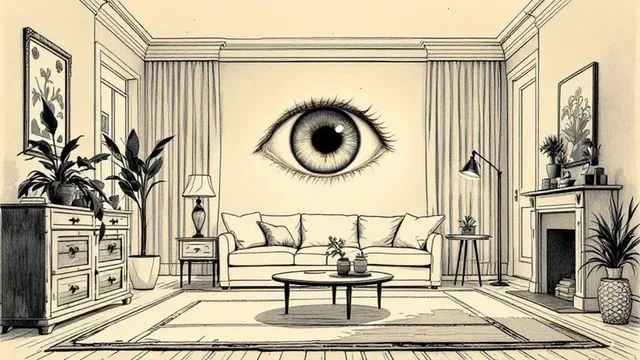
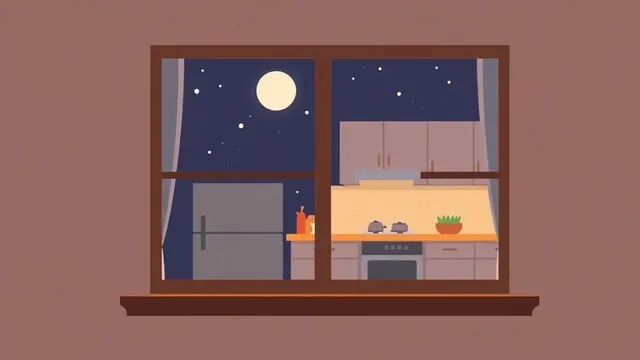
There is no one in your apartment. You know this. And yet — somewhere between the bathroom and the fridge — you tug the hem of your t-shirt down. For who. The radiator? You pour a glass of water and catch your own reflection in the dark window and immediately stand up straighter. You laugh at a podcast and you laugh in a slightly performed way, like there’s a studio audience hidden behind the couch. When you trip over the rug, you say “sorry” out loud. To the rug. You eat a spoonful of peanut butter directly from the jar and feel — somehow — caught. The plant didn’t see anything. The plant has no eyes. And yet the entire performance continues: the small adjustments, the invisible posture, the faint sense that someone, somewhere, is keeping notes. You live alone. You have lived alone for two years. You are still, mysteriously, on stage.
Here’s the thing. Your brain evolved in a world where being watched was the default. For most of human history, you were never alone — you were inside a small group where every burp, every weird face, every grab from the communal stew pot was being tracked by people whose opinion decided whether you ate tomorrow. So your brain installed a permanent low-level audience. Think of it like a live microphone that nobody ever switched off. The show ended, the real audience filed out, the actors went home — but the mic is still hot, still picking up everything, because the one time a mic goes dead at the wrong moment is the one time it matters. Your brain made the same calculation: better to run a phantom audience twenty-four hours a day than to miss the one real one. So it does. Even when you’re eating peanut butter in your kitchen at midnight, the mic is on.
So the next time you apologize to a rug, or fix your posture for a dark window, or eat peanut butter from the jar with the guilty expression of someone being filmed — consider what that weirdness is actually doing for you. It kept every social creature before you in line. It’s the reason you remember to say thank you when no one’s watching, the reason you don’t leave your shopping cart in the middle of the aisle even when the store is empty. The invisible audience is not a bug. It’s the same instinct that made humans cooperative in the first place — the thing that made it possible to share a communal stew pot without someone eating all the good bits and lying about it. It’s a feature. A slightly embarrassing, t-shirt-tugging feature that runs quietly in the background of every empty Tuesday evening. The plant still has no eyes. The dark window is not judging your posture. The rug, for what it’s worth, accepted your apology. The peanut butter saw nothing.